Chang ZENG
Chang ZENG
Home
News
Publications
Skills
Activities
Experience
Posts
Light
Dark
Automatic
3
StepAudio 2.5 Technical Report
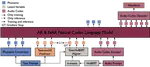
StepAudio 2.5 is a unified audio-language foundation model for ASR, TTS, and realtime spoken interaction with task-tailored RLHF and specialized decoding.
Bin Lin
,
Bo Zhao
,
Boyong Wu
,
Chao Yan
,
Chen Wu
,
Chang Zeng
,
et al.
PDF
Cite
ArXiv
BEAVER: A Training-Free Hierarchical Prompt Compression Method via Structure-Aware Page Selection
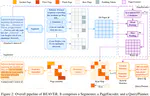
BEAVER is a training-free hierarchical prompt compression framework for long-context LLM inference with strong benchmark performance and 26.4x lower latency on 128k contexts.
Zhengpei Hu
,
Kai Li
,
Dapeng Fu
,
Chang Zeng
,
Yue Li
,
Yuanhao Tang
,
Jianqiang Huang
PDF
Code
Project
Demo
ArXiv
Towards Interactive Intelligence for Digital Humans
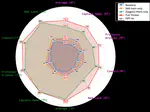
Mio is an end-to-end multimodal interactive digital-human framework that combines reasoning and real-time embodiment with state-of-the-art performance.
Yiyi Cai
,
Xuangeng Chu
,
Xiwei Gao
,
Sitong Gong
,
Yifei Huang
,
Caixin Kang
,
Kunhang Li
,
Haiyang Liu
,
Ruicong Liu
,
Yun Liu
,
Dianwen Ng
,
Zixiong Su
,
Erwin Wu
,
Yuhan Wu
,
Dingkun Yan
,
Tianyu Yan
,
Chang Zeng
,
Bo Zheng
,
You Zhou
PDF
Project
ArXiv
Demo
HAM-TTS: Hierarchical Acoustic Modeling for Token-Based Zero-Shot Text-to-Speech with Model and Data Scaling
We introduce a novel token-based text-to-speech (TTS) model with 0.8B parameters, trained on a mix of real and synthetic data totaling 650k hours, to address issues like pronunciation accuracy and style consistency. This model integrates a latent variable sequence with enhanced acoustic information into the TTS system, reducing errors and style changes. Our training includes data augmentation for improved timbre consistency, and we use a few-shot voice conversion model to generate diverse voices. This approach enables learning of one-to-many mappings in speech, ensuring both diversity and timbre consistency. Our model outperforms VALL-E in pronunciation, style maintenance, and timbre continuity.
Chunhui Wang
,
Chang Zeng
,
Bowen Zhang
,
Ziyang Ma
,
Yefan Zhu
,
Zifeng Cai
,
Jian Zhao
,
Zhonglin Jiang
,
Yong Chen
PDF
Cite
Project
DOI
ArXiv
Cite
×